Arts
More bike lanes in the suburbs? This group is gaining ground.
By Katherine Langford
Advertisement · Why this ad?
Marcus manages the day-to-day editorial workflow across all brands, coordinating coverage assignments and ensuring editorial standards are met. He previously served as city editor at the Pioneer Press and holds a degree in Political Science from Carleton College.
More from Marcus →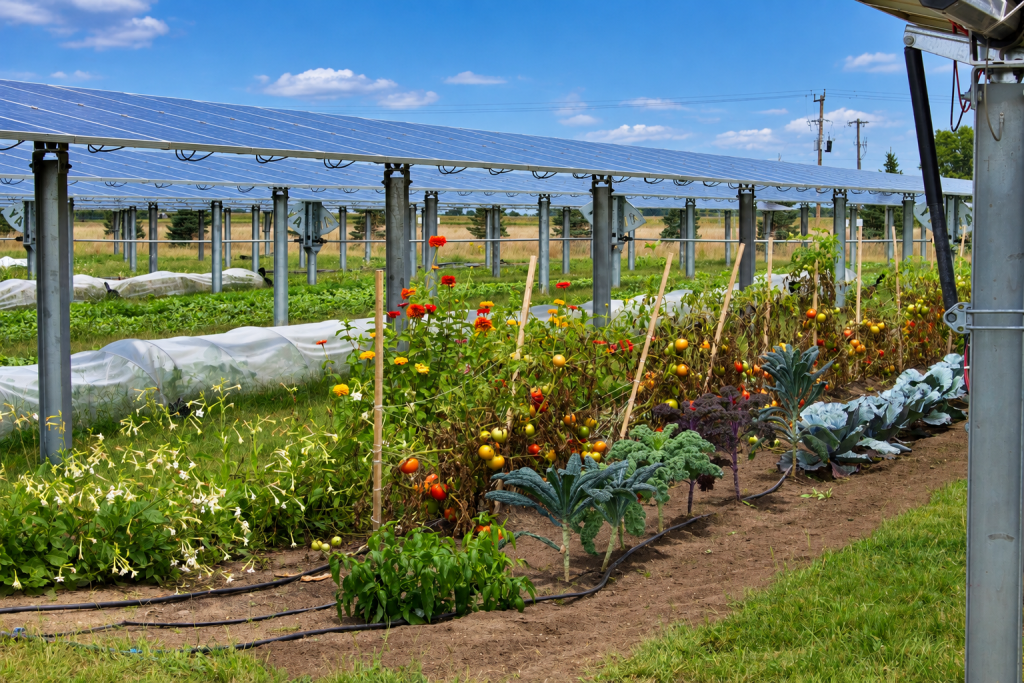
During the growing season, some 2,200 sheep and lambs “mow” the native prairie grasses under and around 1.7 million silicon panels at Xcel Energy’s Sherco solar installation near Becker. As Minnesota’s largest panel farm, the 4,700-acre expanse is also its highest-profile example of agrivoltaics, where solar power production and crops or pasture share the same plots. It’s far from the only one. Sheep graze and honeybees buzz over pollinator-friendly ground cover at other Minnesota solar farms, and more ambitious agrivoltaics initiatives are taking root at a community solar garden near Big Lake , a state-funded experimental livestock operation near Morris and family-owned corn and soybean fields near Olivia. Though not without its challenges — rambunctious livestock, bulky farm equipment — early results show real promise for farmers, energy developers and electric utilities as Minnesota races toward a 2040 deadline to decarbonize its electric grid . Done right, agrivoltaics could address what may be rural Minnesotans’ gravest concern about the coming solar buildout: That more panels mean less room for productive agriculture. “This is something we should prepare for as a state because it’s such a win-win for energy production and farmers,” said Mike Zastoupil, a food systems specialist with the Minnesota Department of Agriculture. “Growing crops or livestock only, you’re at the whims of the market. With renewable energy, you can get a check separate from that.” A bumper crop beneath Big Lake solar panels Agrivoltaics’ potential is evident at Big River Farms, the solar garden near Big Lake. Launched in 2023 as a partnership between US Solar, a Minneapolis-based community solar developer, and The Food Group, an emerging-farmer nonprofit, the 17-acre installation has about nine acres of fenced-in panel rows and eight acres outside the fenceline. Recognizing that most farmers aren’t familiar with cultivating crops under solar panels, the partners used the land outside the fence as a “hedge” during the first three growing seasons, said Peter Schmitt, US Solar’s director of project development. But Big River’s farmers soon came to prefer the security and privacy of fenced-in farming under solar panels. Now, three tenants farm about 20 different food and flower crops inside the array, according to Schmitt. Some are positively flourishing in the partially shaded rows. “We had a bumper cucumber crop that did really well under the array, better than out in the field,” Schmitt said. Bouquet flowers are doing well under the panels, too. When rodents began to proliferate in the predator-free enclosure, threatening yields, the team devised a creative solution: outfitting the fence with a “doggy door” big enough for a coyote to fit through, Schmitt said. With grant funding from the National Laboratory of the Rockies, formerly known as the National Renewable Energy Laboratory, researchers from the University of Minnesota are nearing the end of a two-year study on crop performance among the panels at Big River Farms. The final results won’t be published until next spring, but it’s already evident that leafy greens like kale grow better near the panels than in open fields, said U of M horticulture professor Nathan Eylands, who supervises the research. Related: Xcel doubles down on plan to swap coal for clean power in Minnesota The Big River Farms array has three crop test beds under north-south rows of panels that track the sun as it moves across the sky. Each bed gets a mix of full sun and full shade, giving the plants a break from the heat and radiation of the blazing summer sun while reducing soil moisture loss. “It can be a little too hot and a little too much sun for some of these cool-season crops” in the open field, Eylands said. Working the test beds is also nicer for researchers who spend much of the summer outdoors, too: “You can get into the shade in three steps,” he said. The Big River Farms panels are monofacial, meaning only the top side absorbs photons from the sun. Future research could look at the effects of adding reflective film to the undersides to increase the amount of light reaching plants — and potentially the ambient temperature in the test beds, Eylands said. Eylands’s team is also joining other researchers pushing back on misinformation about solar panels’ effects on soil and water. After a “disheartening” lab meeting to review a litany of anti-solar myths, they decided to test plants grown at Big River Farms for heavy metals like cadmium, which critics falsely claim causes soil toxicity on solar farms. The Big River Farms array has been around long enough that if heavy metal leaching were really a problem, it would be evident in the harvest, Eylands said. “This is great for anyone who wants to dispel these myths. Let’s put some unbiased research in front of them [and show] we can harvest electrons and agricultural products off of the same land,” Eylands said. Providing shade to keep cows cool About 100 miles west of Big River Farms, another group of University of Minnesota researchers oversees two solar arrays modified to allow cows to graze freely underneath. Their take: What’s good for shade-tolerant plants is good for big, warm-blooded animals, too. Just outside Morris, the West Central Research and Outreach Center has maintained cattle-friendly solar arrays for nearly a decade. Internal thermometers show that cows grazing under the panels run half a degree cooler than their open-field counterparts in the heat of the afternoon, dairy professor Brad Heins said at a WCROC conference this summer. “That might not seem like a lot, but in terms of heat stress in a cow, half a degree Fahrenheit can be quite a bit. It can make a big difference in an animal,” he said. Heat-stressed cows tend to walk and pant as they try to dissipate heat, meaning they tire and lose water faster, Heins added. Pedometer data and field observations showed the animals moving less and drinking more water in shaded pastures. Of course, grazing cows have to move to find fresh forage. Last year, Heins and his colleagues built a trailer-mounted, self-powered “mobile solar shade power station” that can follow and shade about 25 cows. The results were promising enough that they plan to build one big enough for 40 cows. “This is a proof of concept,” he said. “We will see where it goes in the future.” Both Heins and Schmitt say that while it’s fair to worry that animals weighing in at 1,000 pounds or more might damage top-heavy solar arrays, the risk is overblown. Schmitt said he was reassured by the results of an accidental “experiment” at a US Solar installation in Colorado, where an uninvited herd wandered for three days and caused no harm. Heins said it’s his “personal view” that tractors and people are more likely to damage solar equipment than cows. Related: Plug and play: Bill would power up plug-in solar power in Minnesota homes “I think we should be able to put cows under the [same] panels that we put out on the landscape with no issues,” he said. Solar panels do need to sit higher than normal to accommodate cows. Sheep and lower-set crops — leafy greens, potatoes, carrots and the like — can easily fit under standard-height panels. For each additional foot the mounts rise aboveground, the foundations need to sink at least one foot further belowground, raising the cost of building the array and potentially making colocated agriculture less profitable, said Aaron Hanson, an energy program specialist with the University of Minnesota. That tradeoff is one reason why some energy and agriculture experts see sheep as an ideal animal companion for solar, along with their lower mass and docility, Hanson said. Then again, Americans consume vast quantities of cow dairy and 85 times more beef than lamb meat . Cotton and cheap synthetic fibers dominate the textile market to wool’s detriment. So, without significant shifts in consumer
By Katherine Langford
By Marcus Chen

By Marcus Chen

By Katherine Langford